How to Upload Files to Amazon S3 Glacier
Amazon S3 Glacier is a cloud service dedicated to storing archived data that is not likely to be retrieved oft. In other words, it is designed for infrequently accessed data. Glacier has a loftier latency of information retrieval but offers low pricing and loftier safety for stored archives. In this article, we are going to explicate Glacier'south data uploading nuances.
Working with S3 Glacier
Amazon Glacier is a quite cost-constructive solution for the prolonged keeping of important data that is not used often. Information technology is a overnice choice for a visitor that possesses a lot of outdated electronic documentation and wants cheap but safe storage. Amazon does non urge its customers to store more or less at that place, though Glacier'due south optimal usage model foresees archives to be kept for a longer period of time.
FREE WHITEPAPER
Archiving to the Cloud: Common cold Storage
How to use cold storage - similar Amazon S3 Glacier - cost-effectively and efficiently? Detect out in our whitepaper:

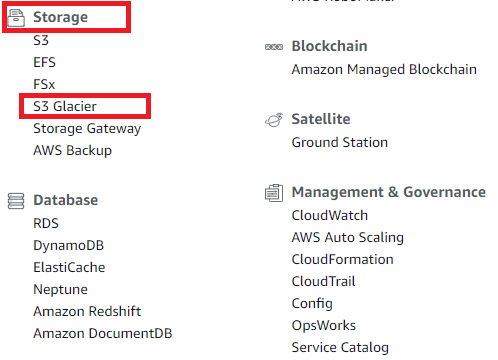
Glacier storage ensures high redundancy, as an annal is stored within multiple facilities at once. The archived information is secured with AES-256 encryption on the server-side. Additional safety is ensured by Vault Lock policies.
The monthly storage price is stock-still and varies from $0.004 to $0.013 per 1GB, depending on the region. Retrieval is gratis for upwards to 10 GB a month. The deletion of data is free if this data was stored for more than 3 months, otherwise, an early deletion fee would be applied.
Further reading Amazon S3 Glacier Pricing Explained
Amazon S3 Glacier Deep Annal storage class is meant for deep archival data that is simply needed very infrequently but tin can't be deleted. Storing 1Gb will price yous $0.00099 per calendar month.

Users have to fix upwards jobs in order to download archives or archive lists in vault snapshots. These jobs run in the groundwork and unremarkably take several hours to complete. At that place are ii ways to upload data
- Direct upload to Glacier from the user's instance.
- Using Amazon S3 lifecycle policies to move information from S3 to Glacier.
Permit'southward explore both of them in detail.
Direct Upload to Glacier
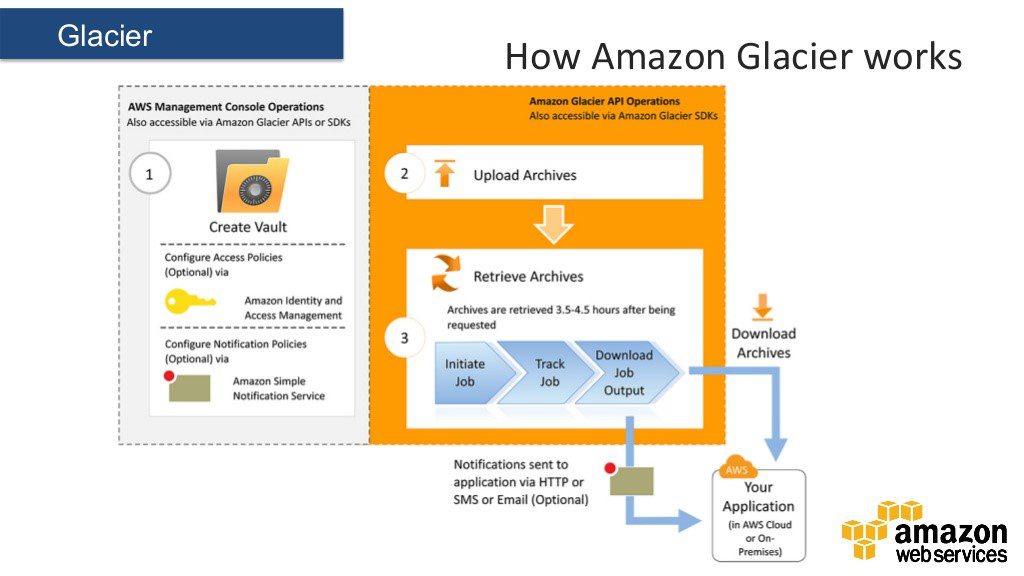
There is no Magician in the AWS console for uploading athenaeum to Glacier vaults. Users have to do that by creating requests via Glacier Residual API or use AWS Software Evolution Kits (or SDKs) for their own applications. All that requires some coding and AWS provides SDKs with Glacier back up for the following programming languages:

- C++.
- Go.
- Coffee.
- JavaScript in Node.js.
- .Internet.
- PHP.
- Python.
- Red.
This way of uploading is, therefore, most user-friendly for users with programming skills or for third-party providers who offering their own tools for S3 Glacier storage management.
Amazon provides two alternative schemes of directly upload to Glacier:
- Upload in a single operation
- Upload in parts
Single operation option is available for upwards to 4GB of data. Upload in parts is recommended for archives bigger than 100MB: it transfers each office in a parallel session (size of parts is specified by the user). If a session fails, only this part would be missing so a user will accept to resend only it solitary. No additional fees are charged for multipart upload.
Scheduled Upload to Glacier from S3
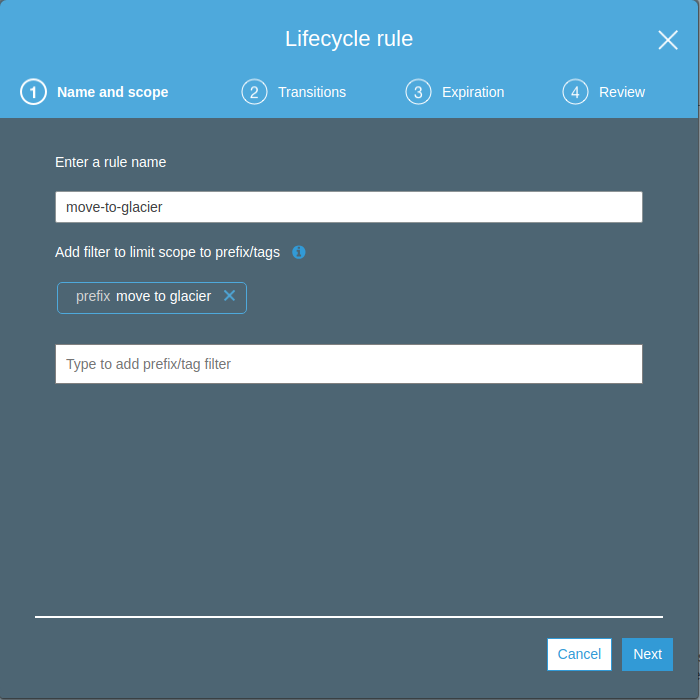
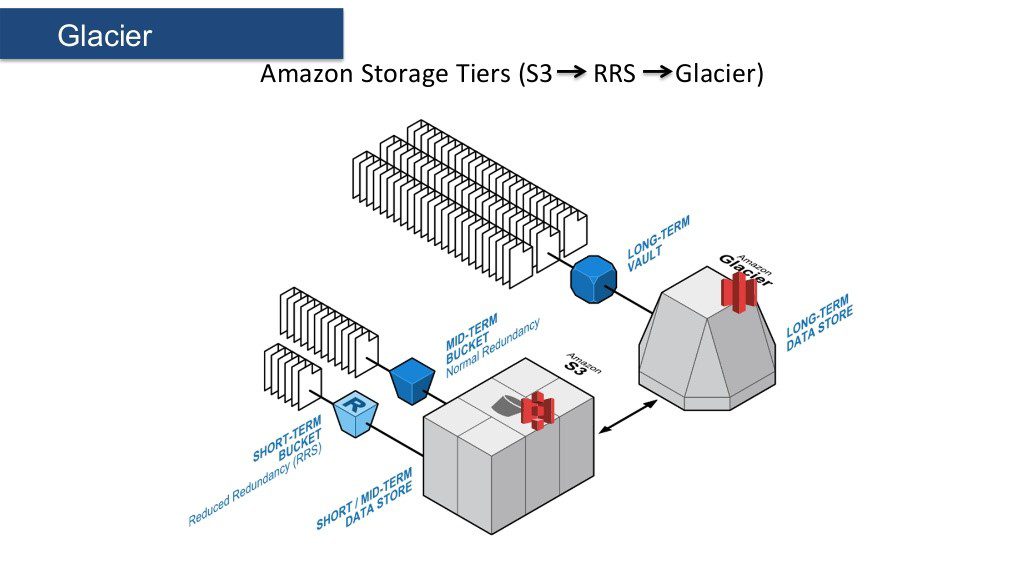
Information that is already in AWS's cloud can exist moved to Glacier storage with the help of the lifecycle policy feature. If you do not urgently demand some of the files stored in an S3 bucket, it is possible to schedule their transfer to a less plush place - that is what these policies are for.
You can create a policy via your AWS console, in the Properties page of your S3 saucepan. Just brand sure that the Archive to the S3 Glacier Storage Class checkbox is selected. After a new policy is created, your data will exist transferred from S3 to Glacier after the time specified. It will non show up in Glacier storage, however - you yet could view it from the S3 bucket. You would have to restore this annal from Glacier earlier any other operations would be available.
Further reading How to Upload Files to S3 Glacier with Lifecycle Rules
Scheduled upload to Glacier is the best option in case the user'south information is already in S3. It is too a more convenient mode for companies with a great menses of electronic documentation because it allows an administrator to automate the archiving of a large number of items. On the downside, this boosted tier of storage results in extra storage fees plus a request fee for archiving to Glacier.
Summary
Both ways of transferring data to Glacier storage have certain pros and cons. Let us summarize their differences to brand the comparison easier.
| Direct Upload to Glacier | Archiving from S3 | |
| Time consumption | Multipart upload allows faster archiving | Scheduled archiving jobs automate the process and save time |
| Fees that apply | Glacier storage fee |
|
| Preconditions | An interface must exist ready programmatically in guild to ship uploading requests to AWS | Data must be stored in S3 in lodge to be transferred to Glacier |
| Visibility | Archives are visible on the Glacier control panel | Archives are not visible on the Glacier side and must be managed via the S3 control console |
MSP360 Backup supports Amazon Glacier and you tin can perform directly uploads of the data to your Glacier storage. Information technology's also possible to create and manage lifecycle policies and transfer archives to Glacier direct from the MSP360 Fill-in user interface.
FREE WHITEPAPER
Providing Backup-every bit-a-Service with MSP360 and Amazon S3
- Amazon S3 storage classes and their use cases
- Pricing principles of Amazon S3
- Monthly cost estimates for Amazon S3 cloud storage and MSP360 Managed Backup – and more

Source: https://www.msp360.com/resources/blog/compare-amazon-glacier-direct-upload-and-glacier-upload-through-amazon-s3/
0 Response to "How to Upload Files to Amazon S3 Glacier"
Post a Comment